Porous Materials: Metal-Organic Frameworks
The discovery of new porous materials is central to addressing global challenges in clean water, energy, and environmental sustainability. Metal–organic frameworks (MOFs) have emerged as a particularly powerful class of materials due to their structural tunability, high surface areas, and wide range of potential applications. Within this field, rare-earth hydroxamate MOFs remain underexplored yet highly promising because of their strong metal–ligand coordination and potential for exceptional stability.
To accelerate discovery, a systematic pipeline has been established in my project that integrates robotic high-throughput synthesis, computer vision, single-crystal X-ray diffraction, and advanced materials characterization. This workflow enables not only the rapid creation of new frameworks, but also their precise structural determination and evaluation for functional applications such as atmospheric water harvesting.
Following, I have shown the sequence of steps that illustrate this research approach.

1. High-throughput MOF Synthesis
In the first step of this research, high-throughput robotic synthesis is employed to rapidly explore the chemical space of rare-earth hydroxamate metal–organic frameworks (MOFs). Automated platforms enable systematic variation of linkers, metal salts, solvents, and modulators, producing up to 96 reactions in a single batch.
Promising crystalline products emerging from this workflow are identified by optical microscopy and subsequently analyzed by single-crystal X-ray diffraction. This accelerated discovery pipeline has already produced eighteen new MOF structures with unique architectures and record water uptake, establishing the foundation for further functional studies.
2. Computer Vision for Crystals Evaluation
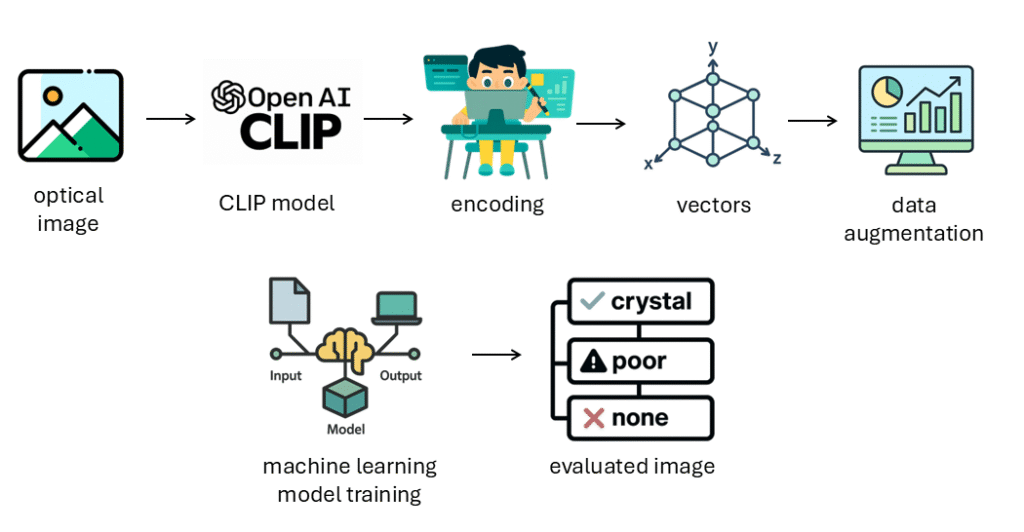
To accelerate the identification of promising products, computer vision and machine learning tools are applied to evaluate crystal quality from optical microscopy images. Models trained on large datasets classify outcomes as crystal, poor, or none, reducing manual screening time and enabling rapid feedback for synthesis optimization.
3. Single Crystal X-ray Diffraction
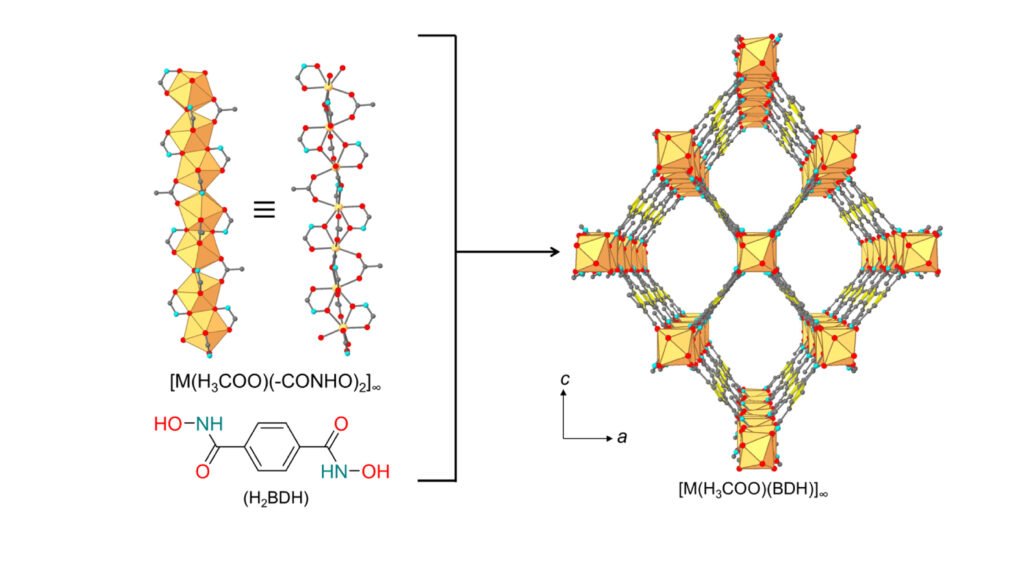
The third step centers on single-crystal X-ray diffraction (SCXRD) to resolve the atomic-level structures of newly synthesized MOFs. High-quality crystals are mounted and analyzed to reveal metal–ligand connectivity, pore geometry, and framework topology.
These structural insights establish the link between synthetic conditions and material architecture, providing the foundation for evaluating stability and functional performance.